A food brand choosing a handled pouch must match the format to product density, fill weight, shelf presentation, carrying frequency and barrier needs—not select a nominal size from a catalogue. By the end, you will have a method for comparing pouch formats, calculating a trial size, specifying materials and testing the finished pack before approval.
Key takeaways
- Use five-side-seal pouches for stable 1–5 kg dry-food packs.
- Measure handled five-side-seal pouch sizes after filling, not before.
- Test handle strength, tipping, stacking and seal performance with the actual food.
- Approve food-contact laminate documents before finalising artwork.
Match the pouch format to the food, weight and selling environment
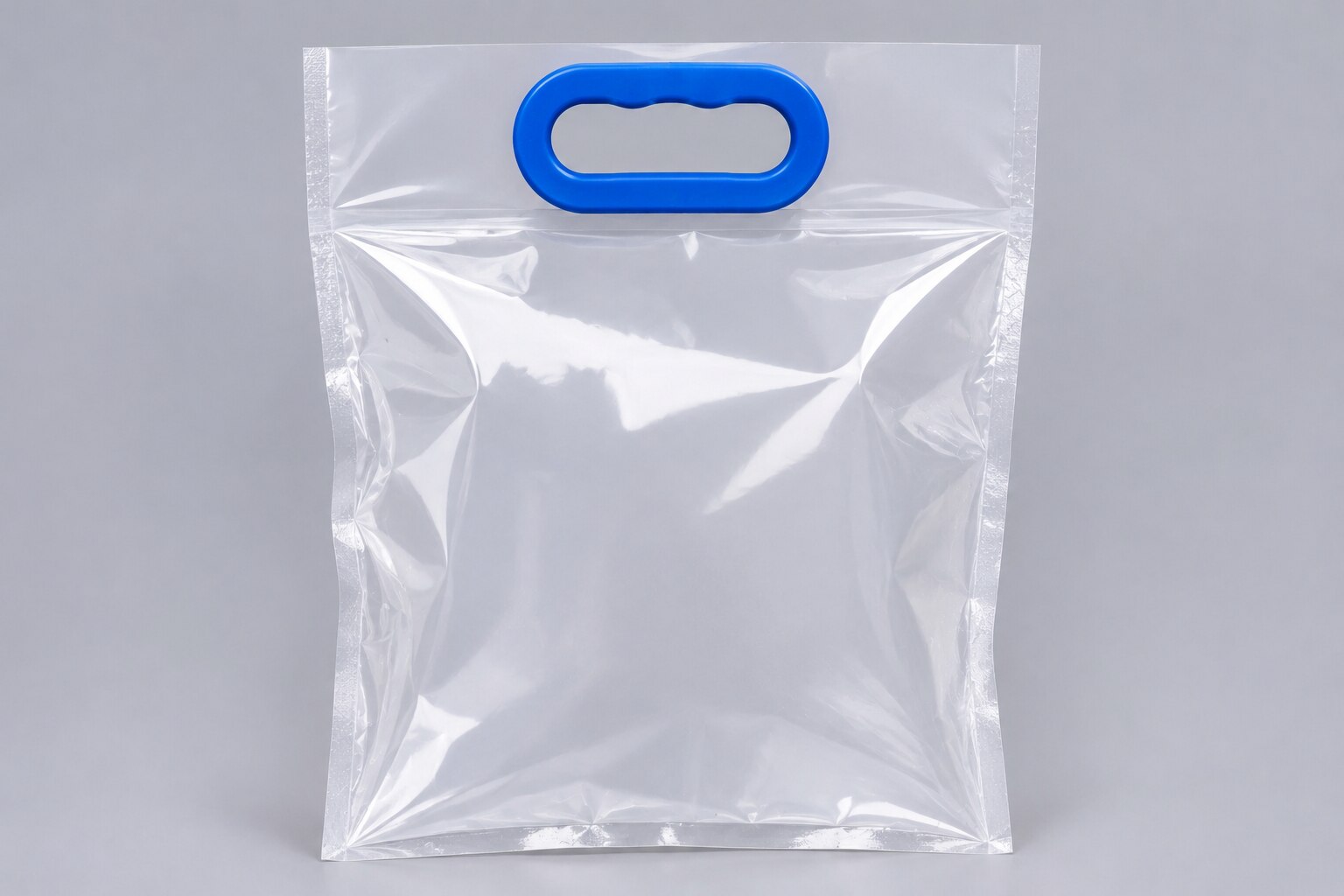
For anyone asking which plastic handle side seal pouch for fits food brands in ahmedabad, the best balance is usually a handled five-side-seal pouch for dry foods sold in 1–5 kg packs, provided the filled pack passes tipping, stacking and carrying trials.
It gives a broad printable face and easier lifting than a flat pouch, but costs more than a centre-seal bag.
Plastic handle side seal pouch options should match product density, protection needs and retail handling:
| Option | Best fit | Main trade-off |
|---|---|---|
| Handled five-side-seal | Namkeen, grains, pulses and larger dry packs carried from shop to home | Convenient and printable, but needs base-stability testing |
| Side-gusset pouch | Dense products needing more volume and a compact footprint | Better capacity, with more forming and sealing cost |
| D-cut three-side-seal pouch | Lightweight snacks and promotional packs | Low cost, but weaker carrying comfort and shelf stability |
| Centre-seal pouch | High-throughput snacks and low-cost distribution | Efficient material use, but limited standing display |
| Spout pouch | Sauces, purees and pourable foods | Easy dispensing, but higher component cost |
| Ordinary carry bag | Short-distance secondary handling | Cheapest option, with poor product protection and presentation |
For dry snacks, namkeen, grains and pulses, choose BOPP/CPP or PET/PE. Roasted snacks, spices, coffee and fatty foods need PET/MPET/PE or another specified barrier laminate; metallised film removes transparent product visibility.
A side seal pouch for food brands must reserve space for net quantity, MRP, packer details and date declarations before fixing the handle. Approve a drawing showing seals, gussets, handle opening and fill opening, then compare quotations on filled-pack performance rather than film price alone.
Choose handled five side seal pouch sizes from filled measurements
Start with volume, not the printed weight. Divide the product’s target weight by its bulk density to calculate product volume, then add the headspace needed for settling, sealing and appearance. A 500 g pack of puffed snacks occupies far more space than 500 g of sugar.
- Weigh the product at its actual target net weight.
- Measure bulk density by filling a known container without compacting the food; density equals weight divided by container volume.
- Add the required headspace volume, then compare that total with the pouch’s usable internal volume after deducting seal widths, handle area and any gusset loss.
- Confirm the result with a filled-pack trial. Check fill presentation, seal position, handle clearance and actual packed height.
These figures provide starting points for handled five side seal pouch sizes, not fixed capacities:
| Size | Indicative net weight | Trial finished dimensions |
|---|---|---|
| 140 × 220 mm | 250 g | Small, low-volume foods |
| 170 × 260 mm | 500 g | Medium-density foods |
| 220 × 330 mm | 1 kg | Grains, pulses or larger snacks |
| 260 × 380 mm | 2 kg | Dense products with reinforced handling |
| 330 × 500 mm | 5 kg | Heavy packs requiring stronger construction |
Specify density and headspace when requesting a side seal pouch for food brands; weight alone produces excess air, crushed product or an overloaded handle. Approve a dimensional drawing showing seal width, gusset depth, fill opening and handle cut-out before comparing quotations.
Check standing stability, handle strength and opening design
A selected pouch is fit only if it stays upright, carries comfortably and opens without damaging the seal. Side-seal construction does not match a stand-up pouch’s base stability, so test the filled pack rather than judging an empty sample.
- Check the filled footprint on the intended shelf. Reject a pouch that tips under light contact, leans after stacking or buckles when packed in a carton.
- Place the handle opening above the product’s centre of mass. For 2–5 kg packs, specify a reinforced handle area, wider load-bearing material, handle patch or carry hole; a plain cut-out can tear into the seal.
- Suspend each filled pouch by its handle for the planned carrying time. Inspect the cut-out, handle patch and adjacent seals for stretching, whitening or tearing.
- Test comfort with the actual load. A narrow opening, sharp film edge or handle that pinches the fingers will discourage carrying even when it passes a strength test.
- Specify a tear notch and opening direction that expose the product without ripping the side seal. Add a press-to-close zipper when the food will be used over several servings.
- Open and reseal filled samples repeatedly after transport. Check zipper engagement, powder or oil contamination in the track and leakage when the pouch is laid down.
For plastic handle side seal pouch options, request dimensional drawings showing seal width, handle opening, gusset and fill opening. Include heat-seal testing to ASTM F88/F88M, gross-leak testing to ASTM F2096 and filled carry trials; laminate tensile strength alone does not prove handle safety. Compare these results across food pouch options in ahmedabad before approving production.
Select the laminate and food-contact specification before artwork
Choose the laminate, sealant and food-contact evidence before artwork; changing them later can alter print registration, sealing conditions and the entire qualification cycle.
| Option | Barrier and sealant | Best fit and caution |
|---|---|---|
| BOPP/CPP or PET/PE | Low-to-moderate barrier; CPP or PE sealant | Dry snacks, namkeen, grains and pulses with ordinary retail life |
| PET/MPET/PE | Stronger oxygen, light and aroma barrier; PE sealant | Roasted snacks, spices, coffee and fatty foods; metallisation prevents transparent display and microwave visibility |
| Reinforced PET/PE or PET/MPET/PE | Higher-gauge layers and wider seal area | Dense 2–5 kg packs; confirm handle and seal strength through filled trials |
| Compatible mono-material PE | Recyclability-led construction; PE sealant | Brands pursuing an EPR or recyclability objective; confirm barrier performance before approval |
Compare food pouch options in Ahmedabad against the actual product, filling temperature, storage humidity, transport route and intended retail life. A side seal pouch for food brands needs a sealant that tolerates the product’s oil, powder and sealing temperature; a weak seal lets oxygen and moisture in even when the laminate looks substantial.
Ask for a declaration of compliance covering the finished laminate, adhesive, ink and sealant for the intended food contact. Also request overall and specific migration or extractables data, material specifications, and evidence aligned with India’s Food Safety and Standards (Packaging) Regulations, 2018. Reject a generic “food grade” claim.
Reserve printable space for net quantity, maximum retail price, manufacturer or packer details, date declarations where applicable, and consumer-care information before fixing the handle and dimensions. If the product is microwave-heated, avoid metallised film.
Approve the pouch through filled-pack trials and transport tests
A search for “which plastic handle side seal pouch for fits food brands in Ahmedabad” has a product-specific answer: BOPP/CPP or PET/PE for ordinary dry snacks, PET/MPET/PE for oxygen-, light- or aroma-sensitive foods, and reinforced higher-gauge material for dense 2–5 kg packs. Confirm the choice with filled packs, not film samples.
Require the manufacturer to complete this approval procedure:
- Issue a dimensioned drawing showing finished width and height, seal width, gusset, fill opening, handle cut-out and every seal. “Handled five side seal pouch sizes” can describe different constructions, so do not compare quotations by name alone.
- Fill samples on your actual line with the real product, weight, headspace and sealing settings. Record leaks, wrinkles, seal contamination, standing position and handle comfort.
- Load the pouch with its intended carrying weight, then test handle pull, repeated lifting, stacking and pallet compression. A handle will not correct a weak base or a pouch that tips on the shelf.
- Send filled packs through an agreed transport test covering drops, vibration, compression and the actual warehouse or vehicle temperature range. Set pass limits before testing.
- Approve only after receiving the laminate specification, seal-strength results, food-contact documents and a signed production sample.
For food pouch options in Ahmedabad, Amples Laminates LLP should show the exact approved construction and retained sample in the quotation, preventing a cheaper but weaker substitute during production. Also reserve space for net quantity, MRP, packer details and date declarations before finalising the handle position.
Related products
 | Side Seal Pouches Plastic Handle with 5 Side Seal Pouch Manufacturers We are also supply in Andhra Pradesh, Arunachal Pradesh, Assam, Bihar, Chhattisgarh, Goa, Gujarat, Haryana, Himachal Pradesh,... View product → |
 | Side Gusset Pouch Plastic Handle with Side Gusset Pouch Manufacturers We are also supply in Andhra Pradesh, Arunachal Pradesh, Assam, Bihar, Chhattisgarh, Goa, Gujarat, Haryana, Himachal Pradesh,... View product → |
Frequently asked questions
Which plastic handle side seal pouch fits Ahmedabad food brands?
A handled five-side-seal pouch fits dry foods sold in 1–5 kg packs when filled-pack trials confirm stability, seal performance and carrying strength.
How should you choose handled five-side-seal pouch sizes?
Select the size from the filled product dimensions, including headspace, seal width, gusset shape and handle clearance.
What should you test before approving a side seal pouch for food brands?
Test standing stability, handle strength, opening performance, seal integrity, stacking and transport using filled packs.
Which laminate specification should food brands approve before artwork?
Confirm the food-contact declaration, layer structure, barrier needs, sealant type, ink suitability and migration documentation before approving artwork.
Keywords