
Products moving through international supply chains encounter conditions that may be very different from those in local distribution. Longer transit periods, multiple handling stages, temperature fluctuations, humidity and storage delays can all affect packaged goods. Export quality packaging must be designed around these conditions rather than judged only by its appearance.
For exporters in Gujarat, packaging decisions can influence product protection, container utilisation, buyer acceptance and the risk of damage during transportation.
Export Packaging Must Match the Product
The phrase “export quality” does not refer to one universal laminate or pouch style. A structure suitable for dry food may not work for liquid, oily, sharp-edged or heat-processed products.
Packaging development should consider:
- Product sensitivity to moisture and oxygen
- Oil or grease content
- Aroma retention requirements
- Puncture risk
- Filling temperature
- Required shelf life
- Transit duration
- Climate at the destination
- Secondary packing method
The right laminate is determined by the complete application. Using an unnecessarily complex structure can increase cost, while under-specifying the packaging may expose the product to avoidable deterioration.
Barrier Protection During Transit
Barrier properties control how readily moisture, oxygen, aroma or light can move through the package. Products such as spices, snacks, dehydrated foods and powdered ingredients may lose quality if moisture enters the pouch. Other goods can oxidise, lose aroma or change colour when exposed to oxygen or light.
A packaging manufacturer may combine different films to achieve the required balance of printability, strength, barrier performance and sealability. The final selection should be based on product trials and relevant testing rather than assumptions.
Seal Integrity Is Critical
A well-designed film structure can still fail if pouch seals are weak or contaminated during filling. Export packaging must remain intact through handling, stacking and transport vibration.
Seal performance depends on several factors:
- Sealant-layer compatibility
- Correct sealing temperature
- Adequate pressure and dwell time
- Clean sealing surfaces
- Uniform pouch dimensions
- Suitable headspace
- Protection from sharp product edges
Manufacturers should communicate recommended sealing conditions, while packers should monitor their filling equipment and sealing jaws.
Printing and Regulatory Information
Export packaging often needs more information than domestic packaging. Requirements can vary by product category and destination market, so exporters should obtain appropriate regulatory guidance before approving artwork.
The printed panel may need to accommodate:
- Product name and description
- Ingredients or composition
- Net quantity
- Batch identification
- Manufacturing and expiry details
- Storage instructions
- Country of origin
- Importer or distributor details
- Handling symbols
- Market-specific declarations
Artwork should be checked carefully before cylinder or plate development. Even a technically correct pouch can become unusable if mandatory information is missing or inaccurate.
Test Packaging in Realistic Conditions
Laboratory data is helpful, but practical trials provide additional insight. A trial batch can be filled, sealed, packed into cartons and observed under expected storage and transportation conditions.
Depending on the product, evaluation may include leakage checks, drop tests, compression assessment, seal-strength testing and shelf-life observation. For vacuum or retort applications, more specialised validation may be necessary.
Gujarat’s Role in Export Manufacturing
Gujarat’s ports and industrial corridors support exporters across food, agriculture, chemicals, engineering and consumer goods. Businesses shipping from Ahmedabad, Vadodara, Surat, Rajkot and other manufacturing centres need packaging that integrates with their production and export logistics.
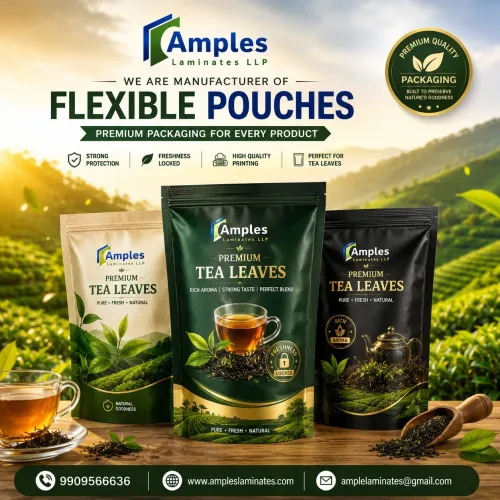
Amples Laminates LLP develops laminated pouch solutions for businesses with domestic and export-oriented requirements. Buyers should present destination details, shipping conditions and product characteristics during development so the packaging can be evaluated for the actual supply chain.
Export quality packaging is achieved through appropriate material selection, controlled conversion, accurate printing and verified sealing performance. Treating these elements as part of export planning helps protect both the shipment and the reputation of the brand receiving it.
Keywords