A grain pouch must match the product, filling line, storage humidity, transport abuse, and retail format—not just the net weight printed on the artwork. By the end, you will be able to specify the pouch dimensions, laminate structure, seal requirements, supplier documents, and production tests needed for reliable grain packaging in Ahmedabad.
Key takeaways
- Size pouches from bulk density and filled dimensions, not label weight alone.
- Specify laminate layers for moisture, oxygen, light, and puncture resistance.
- Test filled pouches through sealing, stacking, handling, and transport conditions.
- Require measurable film, seal, tolerance, and performance details in quotations.
How a center-seal grain pouch is built—and how it differs from other formats
A center-seal grain pouch starts as one flexible web folded around the product. Its longitudinal rear seam runs along the back, while two transverse end seals close the top and bottom, leaving the top opening edge available for filling before the final seal.
Specify the seal width in millimetres; add a gusset when extra volume and a broader base are needed.
Choose the rear seam carefully. A lap seal overlaps film edges, giving a flatter appearance and lower material use; a fin seal joins inner surfaces, creating a taller raised seam with more seal area but greater material consumption. That fin can catch or interfere during carton packing, palletising, or shrink-wrapping.
| Format | Usable volume | Filling and retail behaviour | Stacking and material use |
|---|---|---|---|
| Center seal | Moderate | Fast on form-fill-seal equipment; clean front display | Fair stability; economical film use |
| Three-side seal | Lower for the same film width | Easy opening and strong retail presentation; slower filling | Flat packs stack neatly; extra end-seal material |
| Center-seal gusset | Higher | Fast filling with a fuller shelf profile | Better standing stability; more folds and film |
Woven PP bags suit larger quantities and severe transport handling. Stitching creates needle-hole leakage paths; PE coating or an inner PE liner improves containment, while adding material affects recycling and cost. These center seal grain bags suit retail quantities better than heavy-duty bulk handling.
Choose dimensions from grain bulk density, not from the label weight alone
Calculate product volume before selecting dimensions: volume in litres equals net weight in kilograms divided by measured bulk density in kilograms per litre. For grain center seal pouches in Ahmedabad, measure the actual lot after normal handling, not a catalogue density.
| Fill size | Required product volume |
|---|---|
| 500 g | 0.5 ÷ bulk density |
| 1 kg | 1.0 ÷ bulk density |
| 5 kg | 5.0 ÷ bulk density |
| Larger fills | Net kilograms ÷ bulk density |
Add room for headspace, filling variation, seal clearance, and the selected gusset. Do not convert these volumes directly into pouch length; run a filled trial.
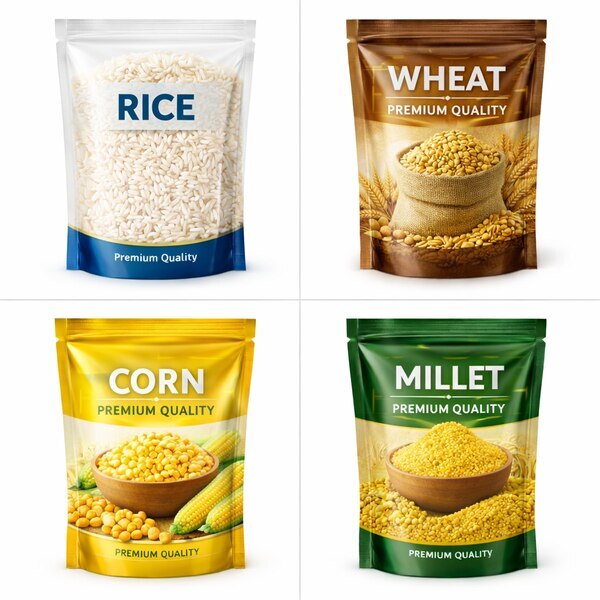
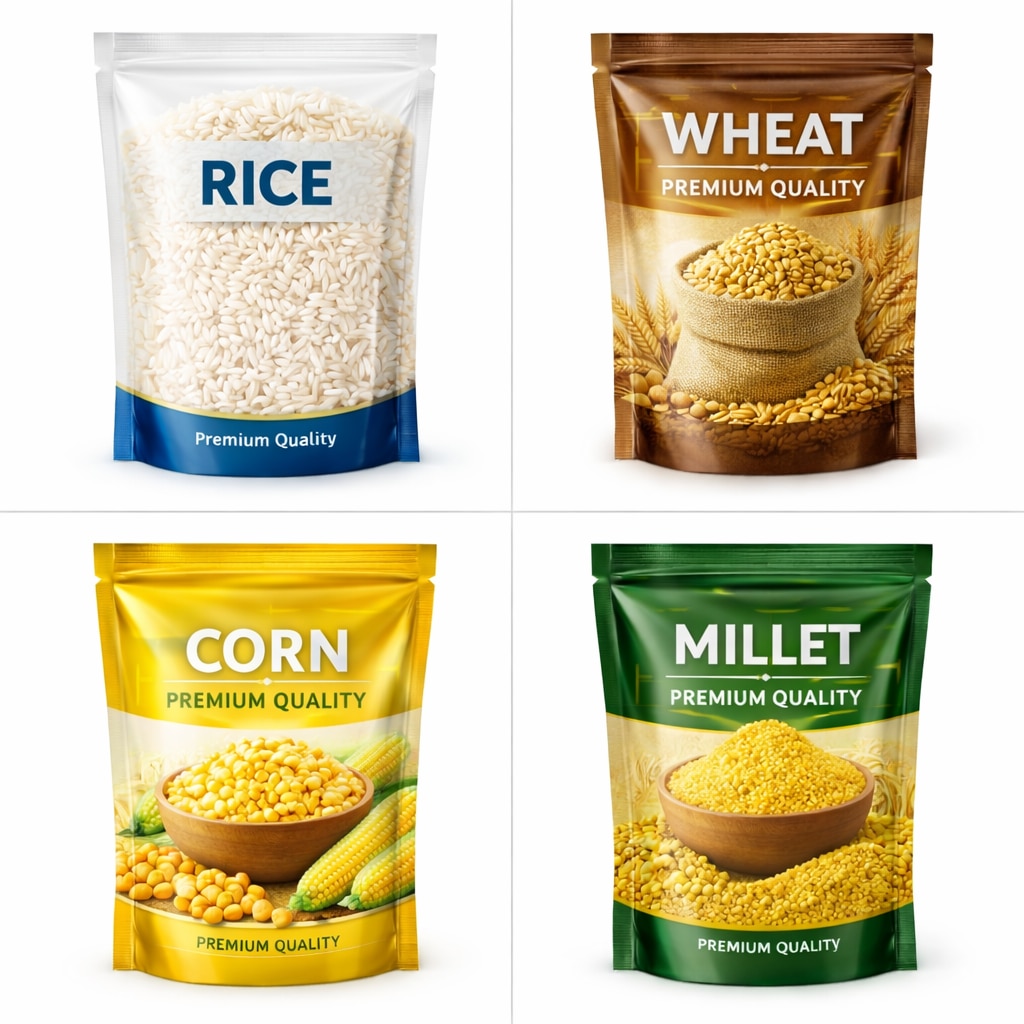
Rice, wheat, pulses, millets, maize, flour, and broken grain fill differently. Whole grains flow and settle differently from dusty flour; irregular pulses and broken grain bridge, while fines migrate into seals. Sharp edges raise puncture risk. Keep the seal zone clean.
The trial must confirm fill height, pouch length, top-seal width, squareness, opening access, pallet pattern, and stability without loading the end seals. A gusset adds usable volume and improves stacking when the pack needs a broader base.
It also adds folds, material, crease points, and inspection requirements; omit it when the added capacity or stability is unnecessary.
Specify moisture, oxygen, light, and puncture protection as a laminate structure
For rice, wheat, pulses, and flour in humid storage, control moisture first: a low water-vapour transmission rate (WVTR) prevents softening, caking, mould growth, and weight change. Oxygen transmission rate matters for rancidity and insects, but it usually comes after moisture protection.
Plain woven PP or uncoated PE resists handling damage without automatically blocking moisture; PE liners, PE lamination, and high-barrier laminates provide progressively stronger protection.
| Structure | Stiffness and printability | Sealing and puncture | Light, recycling, and cost |
|---|---|---|---|
| PET/PE | High stiffness; sharp print | Reliable PE heat seal; moderate puncture resistance | No light shield; simpler recycling; medium cost |
| BOPP/PE | Good stiffness and print gloss | Good seal; lower puncture tolerance than PET | No light shield; simpler recycling; often lower cost |
| PET/metallized PET/PE | Stiff; excellent print surface | PE seal; good puncture resistance | Strong light and moisture barrier; difficult recycling; highest cost |
| Woven-PP/PE | High abuse resistance; print quality depends on coating | PE seals or stitched paths; strong puncture resistance | Limited light barrier unless opaque; difficult recycling; economical for large packs |
Metallization stops protecting effectively where flexing, creasing, pinholes, or delamination damage the metal layer.
- Specify every layer, thickness or grammage, food-contact layer, adhesive system, bond strength, seal strength, WVTR, and intended humidity and storage duration.
- Reject “food-grade laminate” or thickness-only approval without the exact structure and test results.
Test the filled pouch and eliminate failures on the packing line
Approve the pouch on the production line, not from flat film alone. Use the intended grain, target line speed, sealing temperature, dwell time, jaw pressure, and cooling time.
1. Run a filled-pouch trial at normal speed. Check pouch length, tracking, squareness, fill height, headspace, and whether grain reaches either seal.
2. Inspect each seal after cooling. Peel samples across the fin and end seals; look for weak bonds, wrinkles, channel leaks, and grain or powder trapped in the seal.
3. Leak-test filled pouches, then drop them from the specified handling height onto their base, edge, and face. Follow with compression or stacking trials using the planned pallet load.
4. Perform hot-tack testing at the selected temperature, dwell, pressure, and cooling settings. Final seal strength does not replace it: a seal can pass after cooling yet open while freshly packed bags are stacked.
5. Record failures by cause and correction. Weak fin seals require correct jaw alignment and calibrated pressure; channel leaks require clean seal zones; wrinkled seals require stable web tension and controlled cooling. Dust contamination needs cleaner filling and adequate headspace, while overfilled packs need a lower fill height.
Misregistration requires correct tracking marks, and inconsistent pouch lengths require inspection of web tension, roll splices, and registration. Repeat the inspection routinely.
Turn a supplier quotation into a measurable pouch specification
A quotation becomes usable only when every blank has a number, test method, or acceptance limit. For a grain pouch manufacturer in Ahmedabad or a grain packaging supplier in Gujarat, put this checklist in the purchase order:
- Finished pouch: width × length, gusset dimensions, fin or lap seal, longitudinal and end-seal widths, and accepted tolerances in millimetres.
- Laminate: layer sequence, each thickness or grammage, total thickness, food-contact layer, ink and adhesive system, WVTR, seal strength, bond strength, and coefficient of friction, with test methods and limits.
- Printed roll: roll width, repeat length, print-registration tolerance, roll length or finished-pouch count, appearance limits, splice limits, splice marking, maximum telescoping, roll hardness, and batch traceability.
- Finished pouch: assign responsibility for slitting, folding, back sealing, cutting, end-seal geometry, squareness, leakage, and seal performance. These operations can invalidate a roll supplier’s laboratory result.
- Require a declaration of conformity and test reports for the exact film, ink, adhesive, and food-contact combination, not a generic certificate.
- Reserve artwork space for commodity name, net quantity, packer details, packing date, maximum retail price, and consumer contact information.
Amples Laminates LLP can be evaluated against this split by reviewing printed-roll controls separately from conversion and filled-pouch trial results.
Related product
 | Center Seal Pouches Manufacturers We are also supply in Andhra Pradesh, Arunachal Pradesh, Assam, Bihar, Chhattisgarh, Goa, Gujarat, Haryana, Himachal Pradesh,... View product → |
Approve the pouch for Ahmedabad’s warehouse, monsoon, and distribution conditions
Approve only after a filled-pouch trial on the intended production line; flat film proves appearance, not handling performance.
1. Fill samples with the actual grain at normal line speed, then condition them at elevated relative humidity representing monsoon warehouse exposure. Inspect moisture pickup, odour, delamination, seal creep, and label adhesion loss.
2. Repeat drop tests and compression or stacking tests after conditioning. Check seal-peel results and leaks, then assess pallet stability, pouch squareness, tracking, seal loading, and damage from forks, straps, and manual handling.
3.
Choose the format against the job: use a standard center seal for moderate quantities, shorter shelf life, and efficient retail display; choose a gusset when extra volume and upright stacking justify added folds; choose a higher-barrier laminate for longer shelf life or humid storage; add an inner liner when woven PP needs moisture protection; choose woven PP for large quantities or severe abuse.
Balance appearance against recycling priorities.
4. Approve the line trial only when dust-free seals, consistent tracking, stable stacks, and intact packs meet written limits. A flat sample cannot expose these failures.
Frequently asked questions
How does a center-seal grain pouch differ from other pouch formats?
It uses one flexible web folded around the grain, with a longitudinal rear seam and transverse top and bottom seals. Compare those seams with side-seal, three-side-seal, and woven-bag constructions for filling, storage, and handling needs.
How should I choose the dimensions of a grain pouch?
Use the grain’s bulk density, target fill weight, settling behaviour, headspace, and required finished dimensions. A label weight alone does not determine pouch size because different grains occupy different volumes.
What laminate protection should a grain pouch have?
Specify the required resistance to moisture vapour, oxygen, light, abrasion, and puncture through named laminate layers and measurable performance targets. Match the structure to the grain, storage duration, warehouse conditions, and distribution handling.
How do you test a filled center-seal grain pouch?
Run filling-line trials, inspect longitudinal and end seals, check leaks and seal contamination, then test filled pouches through stacking, drops, handling, and transport simulation. Record failure location and cause before approving production.
What should a grain pouch supplier quotation include?
Require film thickness, laminate structure, pouch dimensions, weight tolerance, seal width, seal strength target, printing details, roll or pouch count, packing method, and test or inspection requirements.
Keywords