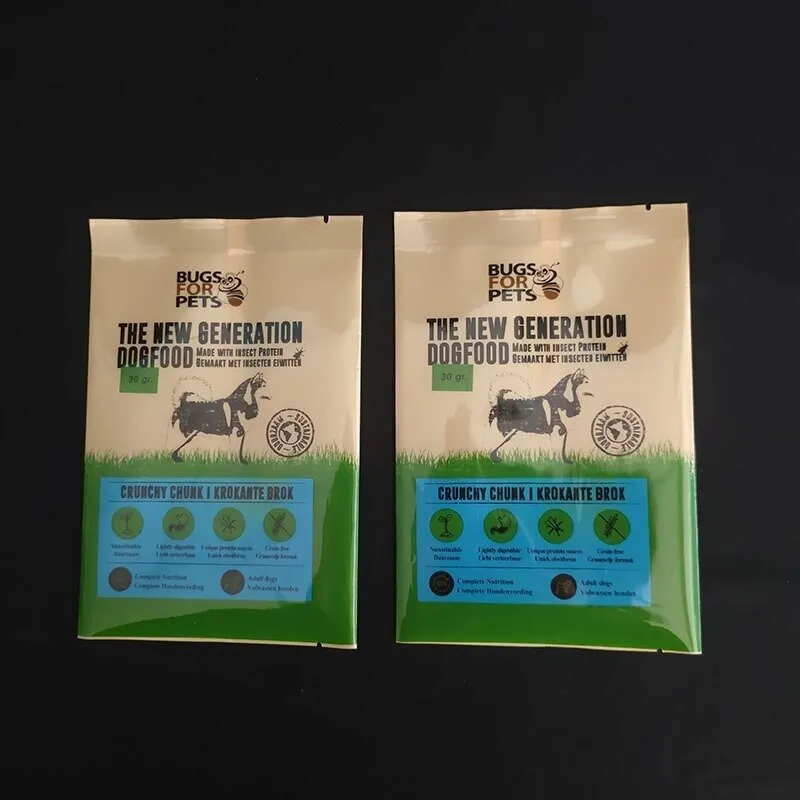
A center-seal pouch can protect pet food from moisture, oxygen, light, grease, odour transfer and puncture damage, but the result depends on the laminate, seal design and filling process—not the pouch shape alone. By comparing barrier data, opening features, shelf presentation and finished-pack testing, you can match each pet-food format to a practical pack specification.
Key takeaways
- Match moisture, oxygen and grease barriers to the recipe.
- Compare center-seal packs with stand-up and shelf-ready formats.
- Specify pouch size, opening, seal dimensions and filling conditions.
- Use seal-strength, leak, drop and transport tests before approval.
Match the Barrier to the Pet-Food Format
Dry kibble needs moisture protection first: humidity softens crunch, accelerates mould risk and reduces palatability. Fatty recipes and treats also need oxygen and grease resistance because oxidation creates rancid odours.
Pet food center seal pouches use a folded rollstock web with a longitudinal seal and two end seals, so dust-free sealing matters as much as the laminate.
| Format | Main protection needed | Barrier direction |
|---|---|---|
| Dry kibble | Moisture, oxygen, grease and puncture resistance | Set WVTR and OTR targets for the intended shelf life; use a tough outer web and sealant that tolerates fat |
| Fatty treats | Oxygen, light, grease and odour protection | Choose a high-barrier laminate, potentially with foil or metallized film, and verify seal integrity after filling |
| Freeze-dried food | Very low moisture transmission and light protection | Prioritise a dry seal zone, strong moisture barrier and puncture resistance; one humidity breach can destroy texture |
| Powdered supplements | Moisture, dust containment and seal cleanliness | Select a sealant with a wide seal window and test for powder contamination in the seal |
| Wet-food sachets | Liquid containment, oxygen protection and strong seals | Match the laminate and seal strength to retort or pasteurisation conditions if the process uses heat |
Printed pet food pouches are not automatically high-barrier packs: ink supplies presentation, while foil, metallized film, EVOH or the sealant structure supplies protection. Compare OTR and WVTR with temperature, humidity, thickness and test method stated; ASTM D3985 is one named OTR method.
Buyers comparing pet food laminated pouches in Ahmedabad should request those conditions, plus migration documentation for the destination market.
Compare Center-Seal Packs with Shelf-Ready Alternatives
A center-seal pouch outperforms a zipper pouch when high-speed filling, low pack weight and efficient case packing matter more than upright display or repeated opening. It loses when shoppers need a stable shelf presence, a wide opening or dependable resealing.
| Format | Main advantage | When center-seal wins or loses |
|---|---|---|
| Center-seal pouch | Continuous graphic panel, efficient rollstock use and fast form-fill-seal production | Wins for single-use kibble, treats and refill packs; loses on shelf stability |
| Zipper stand-up pouch | Upright display, resealing and a wider access opening | Wins for multi-serve food; loses when zipper cost, slower filling or extra material matters |
| Tub | Rigid protection, stackability and easy scoop access | Wins for pantry reuse and repeated handling; loses on freight volume and material weight |
| Metal can | Strong oxygen and light protection for wet food | Wins for wet diets and long ambient storage; loses for dry food, opening convenience and empty-container weight |
| Woven bag | Large capacity and resistance to rough handling | Wins for large kibble sacks; loses unless a liner or laminated inner layer supplies moisture and oxygen protection |
A center-seal pack also gives less usable front-facing area than a stand-up pouch, even when both carry attractive printed pet food pouches artwork. Do not treat printing as proof of protection: specify the laminate, oxygen transmission rate, water-vapour transmission rate and sealant separately.
Choose a zipper pouch when leftovers must stay fresh after opening. Choose a tub when customers reuse the container. Choose a can when wet food needs rigid, hermetic protection; choose center seal when production speed and compact transport matter most.
Set the Size, Opening and Seal Before You Order
A 1 kg pouch should be sized from the filled product, not the nominal volume. Measure bulk density, particle size and settling behaviour, then leave enough headspace for clean sealing without trapping kibble, powder or grease in the seal zone.
Choose the finished width and height around the filling machine’s forming collar, film width and case dimensions. A pillow-style center-seal pouch uses rollstock efficiently and runs quickly, but it will not stand reliably like a stand-up pouch.
If shelf stability matters, specify a gusseted base or change format rather than expecting a flat pouch to balance.
Specify the opening before approving artwork:
- Use a tear notch for single-use treats or small packs.
- Use a zipper when the customer will reopen the pack repeatedly.
- Add a laser score only when controlled opening matters; an uncontrolled tear can split into the seal.
- Keep the notch and score clear of the transverse end seal and product-filled area.
| Feature | Filling and display effect | Main risk |
|---|---|---|
| Flat pillow pouch | Fast filling, compact case packing | Poor upright stability |
| Gusseted center-seal pouch | More usable volume and improved standing | Extra folds can wrinkle and leak |
| Zippered pouch | Better repeat opening | Zipper area can reduce fill speed and seal reliability |
| Tear-notch pouch | Simple, low-part opening | No reseal and possible ragged tear |
Set seal width, seal temperature range and dwell time with the laminate supplier and filling line. Wider seals tolerate minor product contamination better; crushed particles inside the seal create channels that leak. Confirm the pouch fits your stack height, pallet pattern and drop orientation before ordering pet food center seal pouches.
Use Finished-Pack Tests to Control Filling and Transport Risk
Approve the pouch only after filled packs survive the same stresses they will face on the line and in distribution. Test the longitudinal fin seal and both transverse end seals separately; strong barrier film does not prevent leaks caused by wrinkles, trapped kibble dust, fat, poor alignment or inadequate dwell.
Run this validation sequence:
- Fill at the fastest planned line speed using the smallest and largest pack sizes, including product at the highest expected dust or fat load.
- Record sealing temperature, pressure and dwell time, then test a deliberately widened seal window to find the process limits rather than relying on the film supplier’s nominal range.
- Sample packs at start-up, after speed changes and near the end of a run. Measure seal strength with ASTM F88/F88M and reject seals below your specified minimum.
- Use ASTM F1929 dye penetration to expose channels in the center and end seals. Add ASTM F1140 burst testing when you need to challenge the complete pouch.
- Condition filled packs at the agreed storage temperature and humidity, then run drop, compression and vibration testing under an ISTA protocol matching parcel, pallet or truck distribution.
Inspect every failed seal for product contamination, wrinkles, incomplete bonding and misaligned webs. Repeat the test after storage and transport, because a pouch that passes immediately can crack or peel after conditioning.
Give these records to a pet food center seal pouch manufacturer in Ahmedabad: pack mass, filling speed, seal settings, test methods, sample counts, acceptance limits and failure photographs. That turns “leak-proof” into a verifiable supply requirement.
Turn Artwork and Barrier Data into a Supplier Specification
An RFQ should turn a marketing brief into measurable acceptance criteria. State the product format, fill weight, fat level, target shelf life, filling line, storage conditions and destination market before requesting a price.
- Specify the laminate structure, total and layer thicknesses, sealant resin, light protection and the required OTR and WVTR values. Require OTR results under stated temperature, relative humidity, thickness and test-side conditions, using ASTM D3985 where applicable.
- Separate artwork from protection: give spot or process colours, print system, artwork repeat, registration tolerance, barcode grade, scuff-resistance requirement and whether the design is reverse-printed. Printed pet food pouches are not automatically high-barrier pouches.
- Define the center-seal and end-seal requirements, including minimum seal strength, seal-window range, jaw temperature, dwell time and pressure. Ask for contamination testing with kibble dust, powder and fat in the seal area.
- Name finished-pack tests and acceptance limits. ASTM F2096 bubble testing can find gross leaks, but require a validated microleak method when tiny leaks threaten shelf life.
- Identify the compliance file required for the destination: for European Union supply, request Regulation (EC) No 1935/2004 and Regulation (EU) No 10/2011 declarations, migration documentation, and declarations for inks, adhesives and coatings.
- Add dimensions, tolerances, roll direction, splice limits, packing method, sample quantity and change-control rules.
A pet food packaging manufacturer in Gujarat, including Amples Laminates LLP, should be able to quote against this same data rather than guess from a product name. Use the same specification when comparing pet food laminated pouches in Ahmedabad.
Related product
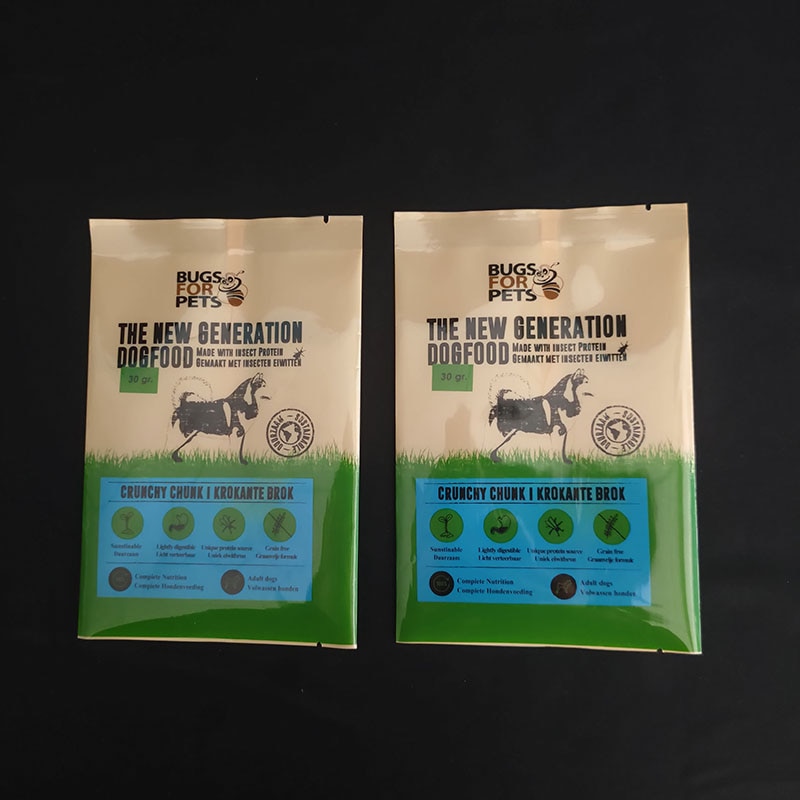 | Center Seal Pouches Manufacturers We are also supply in Andhra Pradesh, Arunachal Pradesh, Assam, Bihar, Chhattisgarh, Goa, Gujarat, Haryana, Himachal Pradesh,... View product → |
Frequently asked questions
Which barrier does dry kibble packaging need?
Start with moisture protection to preserve crunch and reduce mould risk. Add oxygen and grease resistance for fatty recipes and treats, where oxidation can create rancid odours.
How do center-seal pouches compare with shelf-ready alternatives?
Center-seal pouches provide an efficient sealed format with strong printed presentation. Compare them with stand-up or other shelf-ready packs for display footprint, opening experience, stacking and filling-line compatibility.
What should you specify before ordering pet food pouches?
Confirm finished dimensions, fill weight, gusset or profile, opening method, seal width, laminate structure, artwork requirements and the product’s filling conditions.
Which finished-pack tests help control pet food packaging risk?
Use seal-strength checks, leak testing, drop testing, compression or stacking checks, and transport trials. Test filled packs at the planned fill weight and after exposure to expected handling conditions.
Keywords